What helps beyond supplements, ranked by evidence
These are free or close to it, and several have better clinical support than
anything sold in this category. They are also what a continence clinic would start with.
Do not cut your fluids
The instinct when you are leaking is to drink less. It backfires. Concentrated urine
irritates the bladder lining and makes urgency worse, and dehydration raises infection risk. Aim for
normally pale urine, and shift the timing rather than the total — more earlier in the day,
less in the two or three hours before bed.
Test caffeine properly before blaming it
Caffeine is a bladder irritant and a diuretic, and reducing it helps some women
noticeably. But "some" is doing real work in that sentence. Rather than quitting outright, cut it
for two weeks while keeping a diary, then reintroduce it. If your symptoms track the change, you
have your answer. If they do not, you have saved yourself a pointless restriction.
Treat constipation, because it is mechanical
A loaded bowel sits directly against the bladder and pushes on the same pelvic floor
that is meant to be holding things closed. Chronic straining also weakens that floor over time.
This is one of the most overlooked contributors to bladder symptoms and one of the most fixable.
Weight, honestly stated
Abdominal weight increases downward pressure on the pelvic floor, and trials show
that meaningful weight loss reduces stress incontinence episodes in women who are overweight. That
is a real finding and worth knowing. It is also not a quick lever, and it is not the explanation
for every case — plenty of slim women leak.
Stop "just in case" toilet trips
Going pre-emptively, repeatedly, teaches your bladder to signal urgency at ever
smaller volumes. Bladder training reverses this by gradually extending the interval between visits.
It is unglamorous, takes weeks, and has decent evidence behind it for urgency-pattern symptoms.
Review your medication list
Diuretics, some blood pressure drugs, sedatives and certain antidepressants all affect
bladder function. If your symptoms began within a few months of a new prescription, take the actual
boxes to a pharmacist. This costs nothing and occasionally resolves the whole problem.
FemiCore: frequently asked questions
55 questions covering how FemiCore is taken, what is in it, safety and interactions, what the evidence does and does not show, buying and returns. Answers are based on the product label and published ingredient research.
Using FemiCore
What is FemiCore?
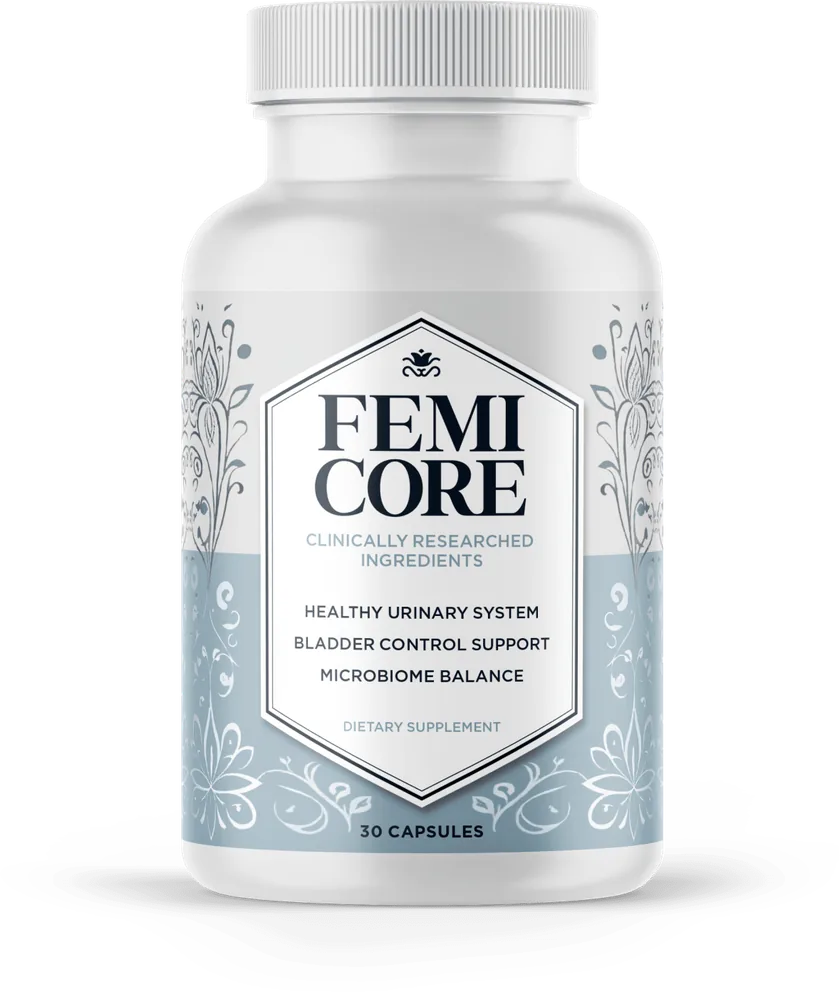
FemiCore is a dietary supplement sold online, direct from the manufacturer. Each bottle holds 30 capsules and the label directs adults to take one capsule daily. The formula combines a 350 mg proprietary herbal blend with a 50 mg proprietary probiotic blend, and is marketed for urinary system and bladder control support.
How do you take FemiCore?
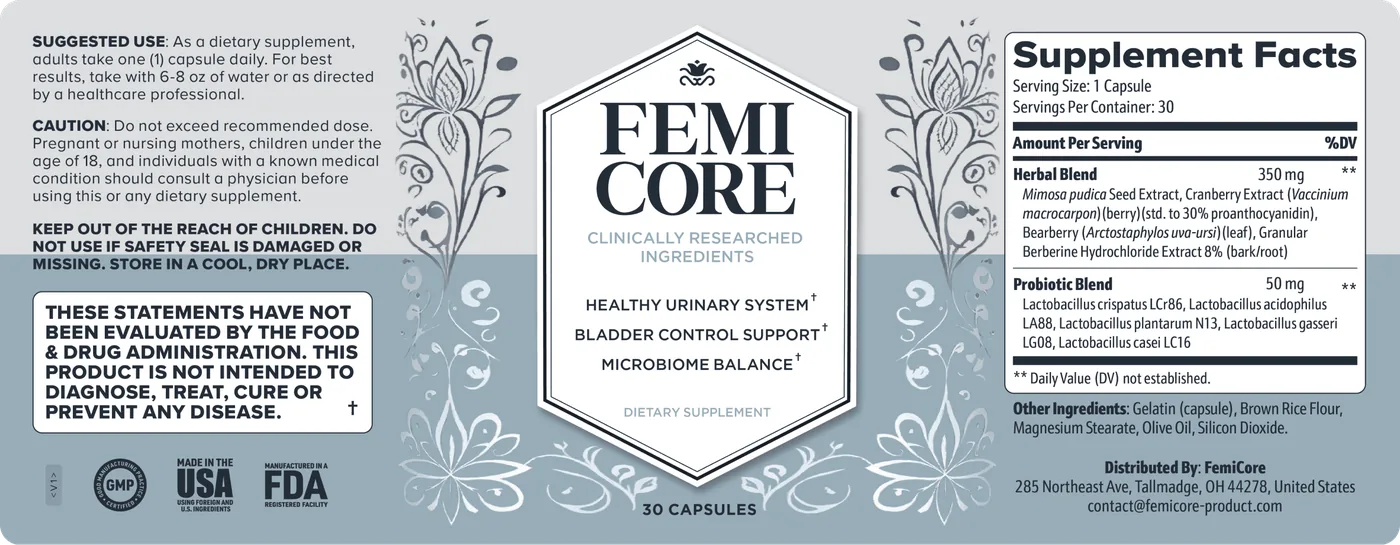
The label directs adults to take one capsule daily with 6-8 oz of water, or as directed by a healthcare professional. It also states not to exceed the recommended dose.
Should FemiCore be taken with food?
The label does not require it to be taken with food. It specifies one capsule with a large glass of water. Some people find botanical extracts such as berberine sit better with a meal, so if you get digestive upset, taking it with food is a reasonable adjustment.
What time of day should I take FemiCore?
The vendor suggests the morning. The label itself only specifies once daily, so consistency matters more than the specific hour. Pick a time you will remember and keep to it.
How many capsules are in a bottle of FemiCore?
Thirty capsules per bottle. At one capsule daily, that is a 30-day supply.
What happens if I miss a dose?
Nothing dramatic. Probiotics and botanical extracts work through consistent use rather than acute dosing, so take the next scheduled capsule as normal. The label warns against exceeding the recommended dose, so do not double up.
Does FemiCore need to be refrigerated?
The label directs you to store it in a cool, dry place, not to refrigerate it. It also says not to use the product if the safety seal is damaged or missing.
Who makes FemiCore and where?
The label lists the distributor as FemiCore, 285 Northeast Ave, Tallmadge, OH 44278, United States, with the contact address contact@femicore-product.com. It states the product is made in the USA in a GMP-certified, FDA-registered facility using foreign and US ingredients.
Ingredients
What are the ingredients in FemiCore?
The herbal blend contains mimosa pudica seed extract, cranberry extract standardised to 30% proanthocyanidin, bearberry (Arctostaphylos uva-ursi) leaf, and granular berberine hydrochloride extract 8%. The probiotic blend contains Lactobacillus crispatus LCr86, L. acidophilus LA88, L. plantarum N13, L. gasseri LG08 and L. casei LC16. Other ingredients are gelatin (capsule), brown rice flour, magnesium stearate, olive oil and silicon dioxide.
How much of each ingredient does FemiCore contain?
The label does not say. Both blends are proprietary, so only the combined totals are disclosed: 350 mg for the herbal blend and 50 mg for the probiotic blend. The amount of any single ingredient is not published.
What is a proprietary blend and why does it matter?
A proprietary blend discloses the total weight of a group of ingredients but not the amount of each one. It is legal and common. The practical consequence is that you cannot check whether any ingredient is present at a dose used in research, and you cannot compare the product against a competitor on a per-ingredient basis.
How many CFUs does FemiCore contain?
The label does not declare a CFU count. Probiotics are measured in colony forming units, the number of live organisms, rather than in milligrams. FemiCore lists its probiotic blend by weight only, at 50 mg total across five strains. Without a CFU figure there is no way to compare it against published probiotic research. This is worth asking the vendor about directly.
What is Lactobacillus crispatus?
Lactobacillus crispatus is a bacterial species that dominates the vaginal microbiome in many healthy women, and its presence is a well-documented marker of a healthy vaginal environment. It has been studied in the context of recurrent urinary tract infections. It is the ingredient in this formula with the most substantial research literature.
Why does FemiCore contain cranberry?
Cranberry proanthocyanidins have been researched for preventing recurrent urinary tract infections. FemiCore's cranberry extract is standardised to 30% proanthocyanidin, which is the fraction that research uses. Because it sits inside a 350 mg proprietary blend with three other ingredients, its individual dose is not disclosed.
What is bearberry or uva-ursi?
Bearberry (Arctostaphylos uva-ursi) is a traditional herbal urinary preparation containing arbutin. Standard herbal guidance limits it to short courses rather than continuous long-term use, and it is generally not recommended during pregnancy or breastfeeding. Since FemiCore is sold as a daily supplement, this is worth raising with a pharmacist if you intend to take it for months.
What does berberine do in this formula?
Berberine is a plant compound with a substantial research literature, mostly around glucose and lipid metabolism and antimicrobial activity. It is also the ingredient in FemiCore most likely to interact with prescription medication, particularly diabetes drugs.
What is mimosa pudica?
Mimosa pudica seed extract is most commonly marketed in digestive cleansing products. There is little quality human research supporting the claims usually made for it.
Is FemiCore vegetarian or vegan?
No. The capsule is made from gelatin, which is animal-derived, so FemiCore is not suitable for vegetarians or vegans.
Does FemiCore contain gluten, dairy, soy or nuts?
The label's other ingredients are gelatin, brown rice flour, magnesium stearate, olive oil and silicon dioxide, none of which are gluten, dairy, soy or nut sources. The label does not carry a formal allergen statement or a certified gluten-free mark, so if you have a diagnosed allergy or coeliac disease, contact the manufacturer before using it.
Does FemiCore contain caffeine or stimulants?
No stimulants appear on the ingredient list.
Is FemiCore third-party tested?
The label states manufacture in a GMP-certified, FDA-registered facility, which describes the facility rather than independent testing of the finished product. No third-party certificate of analysis is published. If independent verification matters to you, request a certificate of analysis from the manufacturer.
Safety
Are there side effects from FemiCore?
The individual ingredients are generally well tolerated at typical doses. Berberine can cause digestive upset in some people. Bearberry is not intended for continuous long-term use. Because the label uses proprietary blends, individual doses cannot be checked. Any new supplement that produces unexpected symptoms should be stopped and discussed with a healthcare professional.
Can I take FemiCore while pregnant or breastfeeding?
The label states that pregnant or nursing mothers should consult a physician before using this or any dietary supplement. Bearberry in particular is generally not recommended during pregnancy or breastfeeding. Do not start it without medical advice.
Can I take FemiCore with diabetes medication?
Speak to your doctor or pharmacist first. Berberine can lower blood sugar, and combining it with diabetes medication may compound that effect. This is the most significant interaction concern in the formula.
Can I take FemiCore with blood thinners?
Check with your prescriber before combining any new supplement with anticoagulant medication. Bring the actual label so they can see the full ingredient list.
Can I take FemiCore with blood pressure medication?
Ask a pharmacist with the label in hand. Berberine has documented interactions with a number of common prescriptions, so a direct check is more reliable than a general answer.
Can I take FemiCore with antibiotics?
Probiotics are commonly taken during and after antibiotic courses, usually spaced a few hours apart so the antibiotic does not act on the probiotic organisms. However, the berberine and bearberry in this formula have their own interaction profiles, so confirm with your pharmacist rather than assuming.
Can I take FemiCore alongside other probiotics?
There is no known harm in doing so, but there is also little point in duplicating strains. If you already take a probiotic, compare the labels before adding another.
Is FemiCore safe for women over 65?
The label sets no upper age limit, but it does direct anyone with a known medical condition to consult a physician first. Older adults are more likely to be on multiple prescriptions, which makes the berberine interaction check more important, not less.
Can I take FemiCore if I have kidney or liver problems?
Consult your doctor. The label directs anyone with a known medical condition to seek medical advice before use, and both kidney and liver conditions change how supplements are processed.
Can men take FemiCore?
The formula is marketed for women and includes strains associated with the vaginal microbiome. Nothing on the label restricts it by sex, but the product is not designed for male urinary anatomy, and men with urinary symptoms should be assessed for prostate causes.
Can under-18s take FemiCore?
No. The label states that children under the age of 18 should consult a physician before using this or any dietary supplement.
What if I take more than one capsule?
The label says not to exceed the recommended dose of one capsule daily. If you have taken significantly more than directed and feel unwell, contact a healthcare professional or a poison information service.
Results
How long does FemiCore take to work?
The vendor suggests a timeframe of weeks rather than days, which is consistent with how probiotics are generally studied. No published trial on the finished formula exists, so there is no independent timeline. If you are trialling it, track your own symptoms with dates so you have something concrete to judge.
Is there clinical research on FemiCore itself?
No published, peer-reviewed clinical trial on the finished FemiCore formula could be identified. There is research on several of the individual ingredients, but ingredient research is not the same as formula research, because dose, form and combination all affect outcomes.
Does FemiCore work for bladder leaks?
We cannot tell you that it will. What can be said factually: the ingredient research in this formula is concentrated on urinary tract infection prevention and vaginal flora rather than on continence. Stress incontinence is primarily a pelvic floor muscle problem, and no ingredient here addresses muscle support. Individual results are not something any supplement can promise.
What should I do if FemiCore does not work for me?
Stop taking it and speak to a doctor or a pelvic health physiotherapist about the underlying cause. Regarding the money, the vendor publishes a refund window with conditions attached - check the current terms on the official site, because they are set by the vendor and can change.
Your symptoms
What is the difference between stress and urge incontinence?
Stress incontinence is leaking during physical pressure such as coughing, laughing, sneezing or lifting, and stems mainly from pelvic floor muscle and connective tissue support. Urge incontinence is a sudden overwhelming need to urinate caused by the bladder muscle contracting when it should not. They have different causes and different treatments, and many women have a mix of both.
Will FemiCore help stress incontinence?
The mechanism does not match the problem. Stress incontinence is a muscle and connective tissue issue, most often following childbirth or menopause, and nothing in this formula addresses muscle support. Pelvic floor muscle training has strong clinical trial support for stress incontinence and is the first-line recommendation in mainstream clinical guidance.
Will FemiCore help overactive bladder?
There is no evidence it treats overactive bladder, and it is not sold as a treatment for it. Overactive bladder is a recognised medical condition with established management options, so it warrants a proper assessment.
Does FemiCore help with urinary tract infections?
It is not a treatment for an active infection and is not sold as one. An active UTI needs medical assessment, because untreated infections can ascend to the kidneys. Several of the ingredients have been researched in the context of preventing recurrence, which is a different question from treating an existing infection.
Can FemiCore help bladder changes during menopause?
Falling oestrogen affects the tissues of the urinary tract and vagina, and genitourinary syndrome of menopause is a recognised condition with specific medical treatments. This is worth discussing with a doctor, since the effective options for it are not supplements.
Will FemiCore help postpartum bladder leaks?
Postpartum leaking is usually pelvic floor related. Pelvic health physiotherapy has strong evidence behind it and is standard care in many countries after childbirth. That is the intervention with the research behind it.
Should I do pelvic floor exercises as well?
Pelvic floor muscle training has stronger clinical evidence for urinary incontinence in women than any supplement in this category, and it is free. The catch is technique - a meaningful share of women contract the wrong muscles when told to do Kegels without instruction. A pelvic health physiotherapist can check your technique in one appointment.
When should I see a doctor rather than buy a supplement?
See a doctor if you have blood in your urine, pain or burning when urinating, fever, back or flank pain, sudden worsening, or leaking that follows surgery or injury. These need diagnosis rather than a supplement.
Buying
Where can I buy FemiCore?
FemiCore is sold direct online only, through the official website. It is not stocked in shops.
Is FemiCore sold on Amazon or in pharmacies?
Not officially. It is a direct-to-consumer online product. Listings appearing on third-party marketplaces are not from the vendor, are not covered by the vendor's returns process, and offer no way to verify what is in the bottle.
How much does FemiCore cost?
Pricing runs on a per-bottle ladder, from around $79 for the smallest order down to roughly $49 per bottle on the six-bottle bundle, with free shipping on the larger bundles. Prices are set by the vendor and change frequently, so confirm current figures on the official page before ordering.
Does FemiCore have a subscription or auto-ship?
The offers presented are one-time bundle purchases rather than a subscription. Before completing any online supplement order, read the checkout page carefully for pre-ticked boxes or recurring billing terms, as these vary by vendor and can change.
Does FemiCore ship internationally?
The vendor lists shipping to the United States, Canada, the United Kingdom, Ireland, Australia and New Zealand. Availability and cost are set by the vendor and can change, so confirm at the official checkout before ordering. If you are outside those countries, this product is not currently available to you.
What is FemiCore's return policy?
The vendor publishes a 60-day money-back window, and their stated terms require returning the bottles together with the packing slip. That is stricter than some comparable offers which accept empty bottles. We do not administer refunds and cannot promise any outcome - read the vendor's current terms at checkout before ordering, keep the packaging and packing slip from the day it arrives, and note your deadline.
How do I contact FemiCore?
The label lists contact@femicore-product.com as the contact address for the distributor, FemiCore, 285 Northeast Ave, Tallmadge, OH 44278, United States.
Comparisons
FemiCore versus a plain cranberry supplement?
A standalone cranberry supplement usually discloses its proanthocyanidin content per serving, which lets you compare it against the research. FemiCore includes cranberry standardised to 30% proanthocyanidin, but inside a proprietary blend, so the per-serving amount is not published. If cranberry is the ingredient you specifically want, a product that states its dose lets you make a more informed comparison.
FemiCore versus D-mannose?
D-mannose is a simple sugar researched specifically in the context of recurrent urinary tract infections, and products typically state the gram dose. FemiCore does not contain D-mannose. They are different ingredients addressing an overlapping question, and the dosing transparency differs.
FemiCore versus a standard women's probiotic?
Most women's probiotics declare a CFU count and the strains included, which allows comparison against published research. FemiCore declares its probiotic blend by weight at 50 mg with no CFU figure, so a direct comparison is not possible from the label alone.
Living with it day to day
How do I know if my pelvic floor is weak?
The clearest everyday sign is leaking during physical effort - coughing, sneezing, laughing, lifting or exercise - because that is the moment the pelvic floor is being asked to hold against pressure. Other indicators include a dragging or heavy sensation low down, reduced sensation during sex, or difficulty stopping wind. Self-assessment only goes so far, though: a pelvic health physiotherapist can assess strength and technique properly in a single appointment, and a meaningful share of women who believe they are contracting correctly are not.
What is a bladder diary and how do I keep one?
It is three consecutive days of notes covering what you drink and when, each time you pass urine and roughly how much, and every leak along with what you were doing at the time. Use a notepad or your phone; it does not need to be formal. It reveals patterns you would not otherwise notice, corrects the substantial misremembering most people do about frequency, and gives a clinician something concrete to work from. It is the single most useful preparation for an appointment.
Does caffeine make bladder leaks worse?
It can. Caffeine is both a bladder irritant and a mild diuretic, and reducing it helps some women noticeably. But the effect varies a lot between individuals, so rather than quitting outright, cut it for two weeks while keeping a diary and then reintroduce it. If symptoms track the change, you have your answer. If they do not, you have avoided an unnecessary restriction.
Should I drink less water to reduce leaks?
No, and this is one of the most common self-inflicted mistakes. Concentrated urine irritates the bladder lining and tends to make urgency worse, while reduced fluid intake raises the risk of urinary tract infection. Aim for urine that is normally pale, and adjust the timing rather than the total - more earlier in the day, less in the two to three hours before bed.
Can losing weight help with bladder leaks?
For women who are overweight, yes. Abdominal weight increases downward pressure on the pelvic floor, and clinical trials show meaningful weight loss reduces stress incontinence episodes. It is a genuine finding rather than a throwaway suggestion. It is also not a fast lever, and it does not explain every case - plenty of slim women experience leaking.
Does constipation affect bladder control?
More than most people expect. A loaded bowel presses directly against the bladder and loads the same pelvic floor that should be holding things closed, and chronic straining weakens that floor over time. It is one of the most overlooked contributors to bladder symptoms and among the most straightforward to address.
How long do pelvic floor exercises take to work?
Supervised programmes typically run about three months, with many women noticing some improvement within six to eight weeks of consistent, correct practice. The two words carrying the weight are consistent and correct - technique is the usual reason people conclude the exercises do not work, which is why a physiotherapist checking your form early is worth more than months of unsupervised effort.
Are bladder leaks just a normal part of getting older?
Common is not the same as normal, and it is certainly not the same as untreatable. Leaking becomes more prevalent with age, but it is a treatable condition rather than an inevitability to be managed with pads. Accepting it as ageing is the main reason women wait years before seeking help, by which point some options are less effective than they would have been earlier.
What will a doctor ask me about bladder leaks?
When leaks happen and what you are doing at the time, how often, whether you wake at night to urinate, your fluid intake, your medication list, and your pregnancy history. They will usually test a urine sample to rule out infection, and may scan your bladder to check you are emptying completely. A bladder diary answers most of these questions before you have to recall anything on the spot.
Can bladder leaks be cured completely, or only managed?
It depends on the cause. Stress incontinence often improves substantially with correct pelvic floor training, and many women become symptom-free. Urgency symptoms driven by infection or irritation frequently resolve once the underlying cause is treated. Some cases are managed rather than cured, particularly where there is significant prolapse or nerve involvement. What is clear is that outcomes are better with proper assessment than with self-treatment, and better the earlier you start.